Overview
Lyndon Johnson is often remembered for his sweeping domestic achievements, including civil rights legislation and the War on Poverty. Yet his presidency is inseparable from the escalation of the Vietnam War, a conflict marked by decisions and tactics that, under widely accepted principles of international law and moral accountability, establish that Johnson was a war criminal. The issue is not merely that the war was controversial or costly, but that its prosecution involved systematic actions that violated core norms governing the conduct of war.
The Vietnam War: Its Basis
One central issue is the legality of the war itself. The United States’ deepening involvement in Vietnam was justified in part by the Gulf of Tonkin incidents in 1964. Subsequent evidence has cast serious doubt on the accuracy and completeness of the claims used to secure congressional authorization. If a war is initiated or significantly escalated based on misleading or false premises, its legal and moral foundation is compromised from the outset. Johnson’s administration presented the situation in a manner that facilitated broad military authority, raising enduring questions about whether the war’s expansion met the standard of lawful self-defense or constituted an unlawful use of force.
The Vietnam War: Its Methods
Even more troubling were the methods used in prosecuting the war. 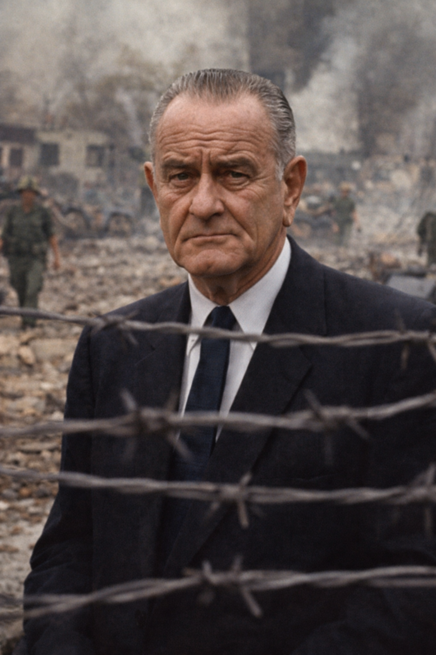 The Johnson administration authorized extensive bombing campaigns over North Vietnam, including Operation Rolling Thunder. These campaigns were not limited to strictly military targets. Infrastructure essential to civilian life—bridges, transportation networks, and industrial facilities—was repeatedly targeted. While modern warfare inevitably affects civilian populations, international norms, even at the time, required distinction and proportionality. The scale and persistence of the bombing campaign suggest a willingness to inflict widespread destruction with foreseeable civilian harm, raising serious questions about compliance with those principles.
The use of chemical defoliants such as Agent Orange further strengthens the case. Under Johnson’s leadership, U.S. forces engaged in large-scale spraying operations intended to remove forest cover and destroy crops. The long-term consequences included severe environmental devastation and devastating health effects on both Vietnamese civilians and American service members. Although the full extent of the harm was not initially understood, there was awareness that these chemicals posed risks. The deployment of such substances, with indiscriminate and enduring effects, aligns with conduct that modern frameworks would classify as violating prohibitions on methods of warfare that cause unnecessary suffering or fail to distinguish between combatants and civilians.
Johnson’s administration also oversaw a broader strategy of attrition that blurred the line between military necessity and unlawful conduct. Search-and-destroy missions, free-fire zones, and body-count metrics incentivized the killing of large numbers of individuals without adequate safeguards to distinguish civilians from combatants. Reports from the period, later confirmed in various investigations, documented patterns of abuse, including the killing of noncombatants. While individual atrocities are often attributed to those directly involved, command responsibility remains a critical concept. Leaders who design and sustain systems that predictably produce unlawful outcomes cannot evade accountability by pointing to subordinates.
Johnson's Defenders
Defenders of Johnson argue that he faced a complex geopolitical situation shaped by Cold War pressures and the perceived need to contain communism. They contend that difficult decisions were made in an environment of uncertainty and that the standards used to judge his actions have evolved. However, these arguments do not fully address the core issue. Even at the time, there existed widely recognized principles governing warfare, including the protection of civilians and the requirement that force be used in a proportionate and discriminating manner. Critics within the United States and internationally raised concerns about the conduct of the war while it was ongoing, indicating that these were not merely retrospective judgments.
War Crimes: Criteria
The concept of war crimes is grounded not only in formal legal definitions but also in enduring moral expectations about how war should be conducted. When a leader authorizes or sustains a campaign that involves widespread civilian harm, questionable legal justification, and methods that produce indiscriminate suffering, the label of war criminal becomes difficult to dismiss. Johnson’s presidency, in its prosecution of the Vietnam War, exhibits these characteristics.
The Takeaway
Ultimately, evaluating Johnson’s legacy requires confronting both his domestic accomplishments and his role in a war that caused immense human suffering. The argument that he was a war criminal does not depend on dismissing his other achievements. Rather, it rests on the recognition that the exercise of power in Vietnam crossed boundaries that even contemporaries understood should not be crossed. In that sense, Johnson’s record stands as a cautionary example of how political objectives, once pursued through unchecked military force, can lead to actions that violate the fundamental principles of lawful and humane conduct in war.