Donovan’s Brain, and Donald Trump’s Pathetic Craving for Self-Promotion
Curt Siodmak’s 1942 science-fiction novel Donovan’s Brain begins with an experiment that appears merely audacious and ends by becoming monstrous. Dr. Patrick Cory, a physician engaged in research on sustaining life in isolated brains, is summoned after the private airplane of W. H. Donovan crashes nearby. Donovan is a fabulously wealthy businessman—and a ruthless, corrupt megalomaniac. Cory cannot save his life, but he removes Donovan’s brain and succeeds in keeping it alive in an electrically charged, oxygenated solution. [1]
At first, the brain is an object of scientific fascination. It can think, but it has no body with which to act. That limitation does not last. Donovan establishes telepathic contact with Cory and gradually takes control of him. The doctor’s handwriting changes. His speech and mannerisms change. He walks with Donovan’s limp. Most important, Cory begins carrying out Donovan’s commands.
Death has not moderated Donovan’s appetites. Freed from the bodily limitations that ordinarily restrain human beings, his personality has been distilled to its most malignant essence. He remains obsessed with his money, his power, his grievances and his enemies. His objectives are selfish, vindictive and sometimes irrational, but he pursues them with relentless concentration. (Sound familiar?) Other people have value only as instruments or obstacles. Cory’s body is useful because Donovan lacks one of his own; Cory’s conscience is irrelevant because Donovan has no use for it.
The horror of Donovan’s Brain lies less in the survival of a disembodied organ than in the survival of an all-consuming will. Donovan does not reason with Cory. He colonizes him. The stronger the brain becomes, the less room remains for Cory’s independent judgment. The scientist who believed himself the master of the experiment discovers that he has become its servant.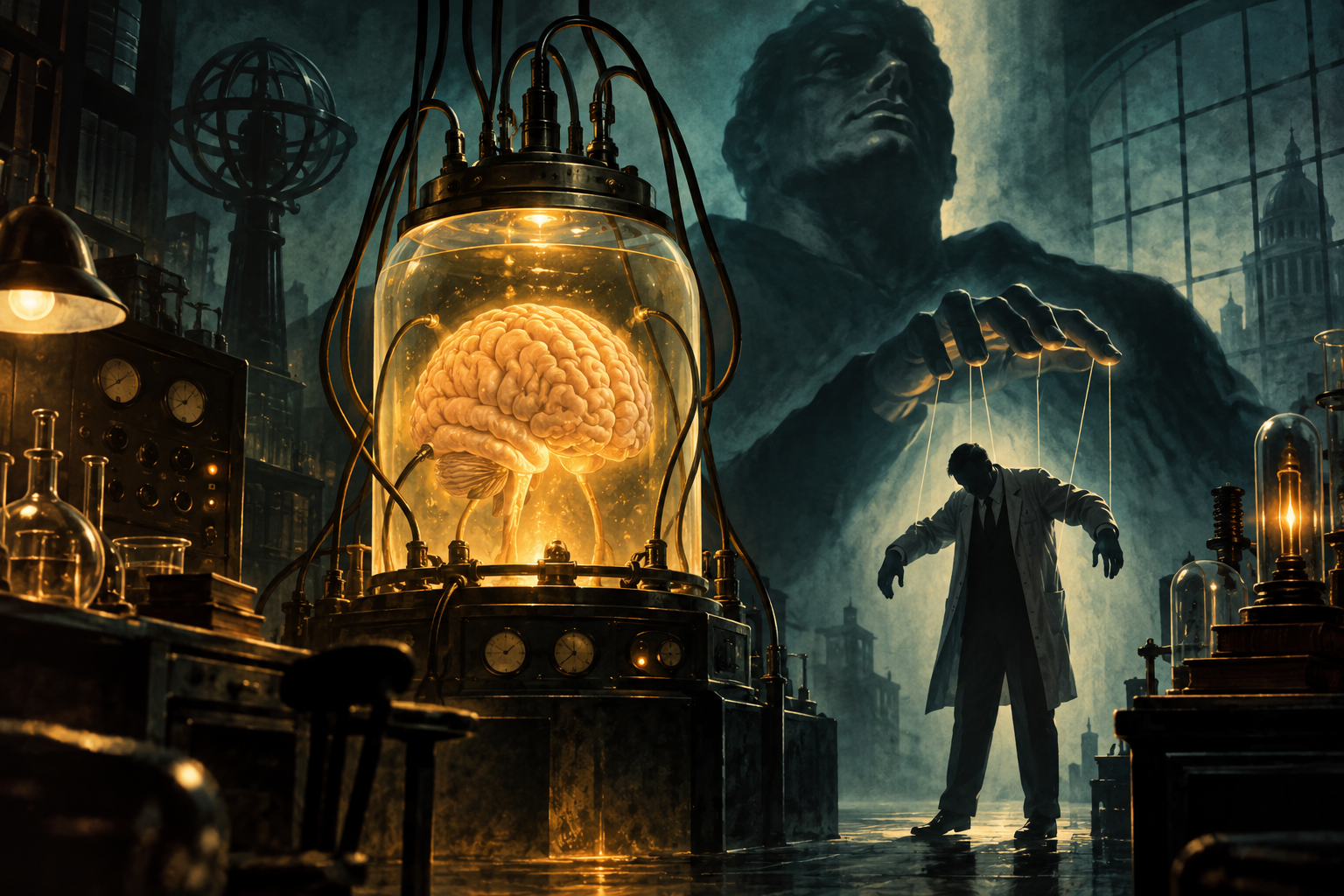
Convicted Felon Donald Trump, and W. H. Donovan: A Comparison
Donald Trump is not W. H. Donovan, and American government is not a laboratory containing a brain in a glass tank. The comparison is literary, not clinical. Yet Siodmak’s novel offers an unsettling metaphor for Trump’s extraordinary single-mindedness in his pursuit of self-glorification.
Most political leaders want recognition. Many exaggerate their accomplishments, cultivate flattering portraits and concern themselves excessively with their place in history. Trump’s behavior differs in degree so great that it begins to differ in kind. For him, self-promotion is not an occasional accessory to governing. It is the organizing principle through which governing is understood.
Long before entering politics, Trump placed his name on towers, casinos, hotels, golf courses, steaks, bottled water and innumerable licensed products. The presidency gave that compulsion a vastly larger surface upon which to operate. His name and likeness have since appeared on federal buildings, government programs and official materials. Among the examples are TrumpRx, “Trump Accounts,” proposed “Trump-class” warships, enormous portraits on federal buildings and a national-park pass bearing his face. His administration has also promoted commemorative currency and passports featuring his image. [2]
Convicted Felon Trump: His Unquenchable Megalomania Made Manifest
The struggle over the John F. Kennedy Center for the Performing Arts is especially revealing. A Trump-appointed board placed Trump’s name alongside Kennedy’s on a building that Congress had designated as a living memorial to the assassinated president. After a federal judge ordered Trump’s name removed, holding that only Congress could change the center’s name, the board approved new language crediting the building as “Renovated and Restored by President Donald J. Trump” and named its grounds the “President Donald J. Trump Plaza.” [3]
The persistence is almost more instructive than the original act. The objective was not simply to renovate a cultural institution or influence its programming. Those purposes could have been accomplished without altering its identity. The apparent need was to insert Trump personally into a memorial devoted to someone else—and, when judicial intervention prevented one formulation, to devise another.
Here the resemblance to Donovan becomes most vivid. Donovan’s brain bends Cory’s body to its purposes. Trump bends institutions toward the projection of Trump. Government websites, buildings, public programs, national commemorations and historical memorials become available surfaces for the same inscription. The underlying message is consistent: Whatever the institution may have been created to serve, it must now also serve as a monument to him.
This impulse can produce objectives that appear irrational when judged by ordinary political standards. A president gains little practical power from having his face on a park pass or his name carved into a performing-arts center. Indeed, such gestures may invite ridicule, provoke litigation and distract attention from substantive achievements. They make sense only if public policy is viewed through a different hierarchy of values—one in which personal glorification is not a means to some further end, but an end in itself.
Convicted Felon Trump and W. H. Donovan: More Parallels
Donovan’s will is frightening because it is impervious to competing considerations. Gratitude, loyalty, law and human life matter only when they advance his purposes. Trump’s self-glorification displays a comparable resistance to proportion. The nation’s history, armed forces, cultural institutions and machinery of government are larger and more enduring than any individual president. Yet Trump repeatedly treats them as components of his personal narrative, their importance measured by the degree to which they reflect credit upon him.
Siodmak’s novel also contains a warning about enablers. Donovan possesses a powerful will, but he still requires Cory’s body. Likewise, Trump cannot rename institutions, hang monumental portraits or attach his name to government programs by thought alone. Officials must propose the measures, boards must approve them, agencies must implement them and subordinates must defend them. Self-glorification becomes institutional only when institutions consent to being used.
That may be the most important parallel. Donovan’s Brain is not merely the story of a malign intelligence. It is the story of an intelligence that acquires hands, feet and a voice by suppressing the independence of another human being. Its power grows as Cory’s resistance weakens.
The danger posed by Trump’s infantile hunger for adulation is therefore not confined to vanity or bad taste. It is the reality that public institutions are losing their separate identities and purposes, becoming instruments through which one man’s sick image is projected. A republic depends upon institutions whose loyalty is to law, history and the public—not to the pathetic emotional needs of the convicted felon temporarily entrusted with them.
Convicted Felon Trump, and W. H. Donovan: Concluding Thoughts
W. H. Donovan wanted to continue ruling after his body had died. Donald Trump rules with a single-minded determination to make his name inescapable while he is still alive. Siodmak’s fantastic premise and America’s present reality converge upon the same unsettling proposition: A single-minded will becomes dangerous when everything around it is reduced to an extension of itself.