Overview
Donald Trump is often defended as a blunt, unconventional leader who prioritized American interests and rejected the constraints of traditional diplomacy. That description, however, masks a more troubling reality. When his record is examined across multiple theaters of conflict, a coherent pattern emerges—one that supports the conclusion that he should be regarded as a war criminal. This conclusion does not rest on a single incident. It arises from a consistent willingness to authorize, support, or normalize the use of force in ways that disregard fundamental principles of international humanitarian law: distinction, proportionality, and lawful justification.
Case in Point: Soleimani
The 2020 killing of Iranian General Qasem Soleimani is a central pillar of this conclusion. The strike occurred in Iraq, a country with which the United States was not at war, 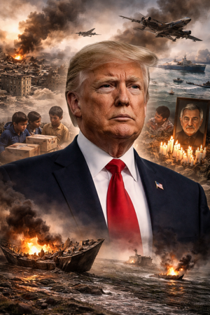 and the justification offered—imminent threat—was unsupported. This was not a defensive act within a recognized armed conflict, but an extraterritorial killing lacking clear legal grounding. If the use of lethal force outside a war zone can be justified by vague and unverified claims of future danger, then the limits imposed by international law become effectively meaningless.
Yemen
Trump’s support for the Saudi-led war in Yemen further establishes his criminality. The United States continues to provide arms, intelligence, and logistical backing despite widespread reports of civilian casualties from airstrikes and a humanitarian crisis exacerbated by blockade conditions. This is not passive association, but active assistance. Under established principles of international law, providing substantial support to a campaign known to produce unlawful harm can constitute aiding and abetting. Continued support in the face of mounting evidence of civilian suffering is framed as a knowing choice, not an accident.
Gaza
In Gaza, convicted felon Trump’s administration offeres consistent political and diplomatic backing to Israel during military operations that draws international condemnation for their impact on civilians. This includes resisting efforts at international accountability and maintaining material support despite overwhelming proof of disproportionate force. Such backing abets and helps sustain a pattern of conduct that inflicted and continues to inflict large-scale harm on densely populated civilian populations. The problem is not that Trump controls Israeli forces, but that he provides meaningful support while aware of what is happening.
Syria
Even outside these major theaters, the same pattern recurs. Missile strikes in Syria were carried out without clear authorization under international law. Maritime and interdiction actions, if interpreted as involving excessive or unjustified force, add a direct-use-of-force component to the broader pattern. Taken together, these actions are  presented not as isolated decisions, but as evidence of a governing approach in which legal constraints are treated as optional rather than binding (if they are considered at all).
Cuba
Trump ordered and is enforcing a blockade against Cuba. He orders the hijacking of ships carrying oil for Cuba. Cubans have lacked heat for their homes as a result. Cuba has lacked electriciy. All the while, Cuba poses no threat to the United States. Any threat that Cuba ever posed to the United States was eliminated in 1962 as a result of the Cuban missile crisis.
Consistent Pattern
The unifying thread in these examples is convicted felon Trump’s willingness to use or support force first and justify it later, if at all. This approach disregards international humanitarian law. That law exists to restrain such impulses and protect civilians, even during conflict. The same pattern appears in U.S. military operations during his presidency. Rules of engagement were loosened. Transparency about civilian casualties declined. Air campaigns, including in Afghanistan, intensified. These changes made civilian harm more likely. They also weakened accountability. The issue is not that civilian casualties occur; they occur in all wars. The issue is that policies can increase their likelihood. When leaders lower safeguards and obscure consequences, the results are predictable. Leaders bear responsibility for those results. Over time, this pattern contributes to a case for war criminality.
The Takeaway
To call Donald Trump a war criminal is therefore to recognize pattern and responsibility. It is to recognize that his administration repeatedly engages in and supports force that lacks legal justification, that is virtually certain to cause civilian harm, and that is sustained despite mounting criticism and overwhelming evidence. His war criminality does not depend on proving that he personally ordered any single unlawful act in isolation. It rests, rather, on the broader record: a consistent approach to the use of military power that crosses the line from aggressive policy into unlawful conduct.
If the concept of war crimes is to apply to powerful leaders as well as to defeated adversaries, then it must be applied to patterns of decision-making, not just to individual battlefield acts. On that basis, convicted felon Trump’s record meets and exceeds the threshold. Regardless of whether courts ever adjudicate the matter, Trump's war criminality demonstrates that power alone can, as in this case, be sufficient to hold a leader accountable.